The Big Bang Theory: The Origins of Everything
How did the universe begin? For millennia, this was a question for philosophers and theologians. Today, it is a cornerstone of modern science. The Big Bang theory is the prevailing cosmological model for the universe from the earliest known periods through its subsequent large-scale evolution.
The Concept of a Beginning
The Big Bang theory suggests that the universe began as a hot, dense point approximately 13.8 billion years ago. It was not an explosion "in" space, but rather the rapid expansion of space itself. In the beginning, all matter and energy were concentrated in a singularity—a point of infinite density and temperature. From this state, the universe has been expanding and cooling for billions of years.
The evidence for this theory is overwhelming. In the 1920s, Edwin Hubble observed that galaxies are moving away from us in all directions, and the further away they are, the faster they are receding. This discovery, known as Hubble's Law, provided the first hint that the universe is expanding. If the universe is expanding today, it must have been smaller in the past.
Modern astronomers have refined this picture with remarkable precision. By combining observations from the Hubble Space Telescope, the Planck satellite, and gravitational lensing surveys, researchers have pinned down the age of the universe at approximately 13.8 billion years, with an uncertainty of less than one percent. This measurement, once a matter of heated debate, now rests on multiple independent lines of evidence that all converge on the same answer—a triumph of modern observational cosmology.
The First Three Minutes
The early universe was a place of extreme physics. In the first fraction of a second, known as the Planck Epoch, our current understanding of physics breaks down. Shortly after, the universe underwent a period of Cosmic Inflation, expanding exponentially faster than the speed of light. This smoothed out any irregularities and set the stage for the formation of galaxies.
As the universe cooled, the first fundamental particles—quarks and electrons—began to form. Within the first three minutes, a process called Big Bang Nucleosynthesis occurred. During this brief window, protons and neutrons fused to form the nuclei of the lightest elements: hydrogen, helium, and trace amounts of lithium. The ratio of these elements observed in the universe today matches the predictions of the Big Bang model with remarkable precision.
The Cosmic Microwave Background (CMB)
For the first 380,000 years, the universe was a hot, opaque plasma of ionized gas. Light could not travel far before being scattered by free electrons. As the universe continued to expand and cool, it reached a temperature where electrons could combine with nuclei to form neutral atoms. This event is known as Recombination.
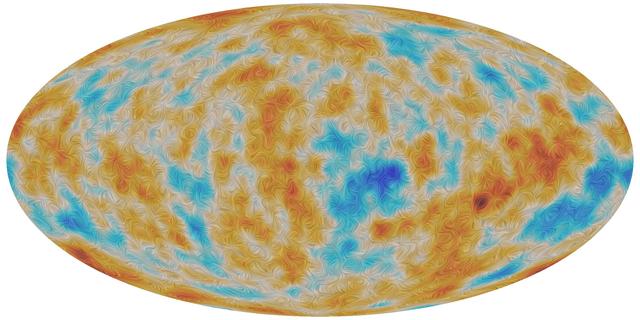
Suddenly, the universe became transparent. The light that was present at that moment was finally free to travel through space. This light, now stretched by the expansion of the universe into the microwave part of the spectrum, is known as the Cosmic Microwave Background (CMB) radiation. Discovered accidentally in 1964 by Arno Penzias and Robert Wilson, the CMB is the "afterglow" of the Big Bang and provides a "baby picture" of the universe as it existed just after the beginning.
Structure Formation: The Birth of Galaxies
The CMB is not perfectly uniform; it contains tiny fluctuations in temperature. These fluctuations represent regions of slightly higher density in the early universe. Over hundreds of millions of years, gravity acted on these dense regions, pulling in more matter and eventually forming the first stars and galaxies. This era, known as the Cosmic Dawn, saw the first light since recombination and transformed the universe from a dark, gas-filled void into the structured cosmos we see today.
Alternative Theories and Challenges
While the Big Bang is the most widely accepted model, it is not without its challenges. Scientists continue to investigate the nature of Dark Matter and Dark Energy, which together make up 95% of the universe but are not accounted for in the standard Big Bang model. Furthermore, what happened "before" the Big Bang remains a subject of intense theoretical research, with some models suggesting a "Big Bounce" or a multiverse scenario.
The Future of the Universe
Based on our current understanding, the expansion of the universe is not slowing down; it is accelerating. This suggests that the universe will continue to expand forever, eventually leading to a "Big Freeze" or "Heat Death," where galaxies become isolated from each other and stars eventually burn out, leaving the universe in a state of maximum entropy and darkness.
Conclusion
The Big Bang theory is a testament to the power of human observation and mathematical reasoning. It provides a coherent narrative for the history of the universe, from a tiny singularity to the vast expanse of galaxies we observe today. As we build more powerful telescopes and conduct more precise experiments, we will undoubtedly refine this model, continuing our journey to understand our cosmic origins.
Sources & Further Reading
- NASA Science: Big Bang: science.nasa.gov
- European Space Agency: Planck Mission: esa.int
- CERN: The Early Universe: home.cern
- Weinberg, S. (1977). The First Three Minutes: A Modern View of the Origin of the Universe.