Dark Matter and Dark Energy: The Invisible Universe
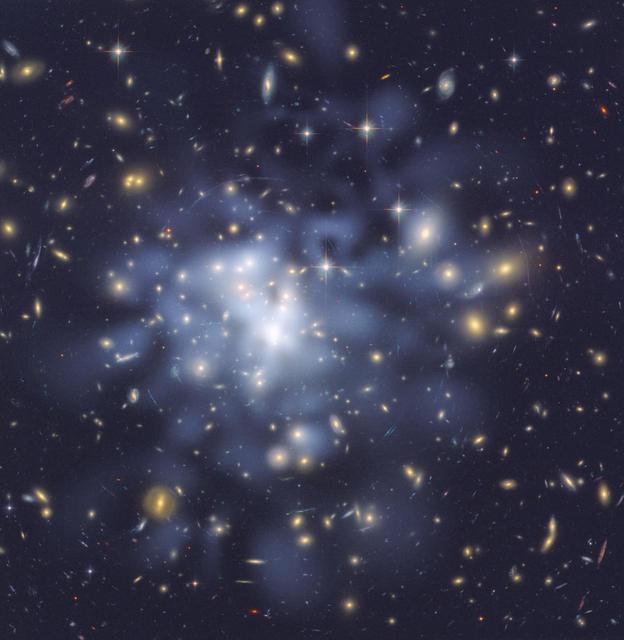
Everything we see—stars, planets, galaxies, and ourselves—makes up less than 5% of the universe. The rest is hidden in the form of dark matter and dark energy, two of the greatest mysteries in modern science.
The Discovery of Dark Matter
The first evidence for dark matter came in the 1930s when Swiss astronomer Fritz Zwicky observed that galaxies in a cluster were moving much faster than the visible matter should allow. He hypothesized that there was "dunkle Materie" (dark matter) providing extra gravity. However, his work was largely ignored for decades.
In the 1970s, Vera Rubin and Kent Ford provided definitive evidence while studying the rotation curves of spiral galaxies. They expected stars at the edges of galaxies to move slower than those at the center, just as planets further from the Sun move slower. Instead, they found that stars at the edges were moving just as fast. This suggested that a massive, invisible halo of matter was surrounding the galaxies, providing the gravitational pull necessary to keep the stars in their orbits.
What is Dark Matter?
Dark matter does not emit, absorb, or reflect light, making it completely invisible to telescopes. We only know it exists because of its gravitational influence on visible matter. Scientists believe it is likely a new type of subatomic particle that interacts only through gravity and possibly the weak nuclear force.
The leading candidates are WIMPs (Weakly Interacting Massive Particles). Experiments deep underground and at the Large Hadron Collider are searching for these elusive particles, but so far, none have been directly detected. Other theories suggest dark matter could be composed of Axions or even primordial black holes.
One of the most compelling pieces of evidence comes from the Bullet Cluster, a pair of colliding galaxy clusters studied in 2006. During the collision, the hot gas (ordinary matter) slowed down due to drag, while the bulk of the mass, mapped through gravitational lensing of background galaxies, passed straight through. This separation between visible matter and gravitational mass is extremely difficult to explain without dark matter, leading most astronomers to conclude it must be real.
The Shock of Dark Energy
While dark matter acts as a "cosmic glue" that holds galaxies together, dark energy acts as a "cosmic repeller" that pushes the universe apart. Until the late 1990s, astronomers believed that the expansion of the universe, initiated by the Big Bang, would eventually slow down due to gravity.
In 1998, two independent teams studying distant supernovae made a shocking discovery: the expansion of the universe is not slowing down—it is accelerating. This unexpected finding suggested the existence of a mysterious force that permeates all of space, pushing galaxies away from each other at an ever-increasing rate. This force was dubbed Dark Energy.
The supernova evidence has since been independently confirmed by two other cosmological probes. Measurements of the Cosmic Microwave Background and the pattern of baryon acoustic oscillations—frozen sound waves from the early universe that serve as a cosmic ruler—both yield the same conclusion: dark energy dominates the energy budget of the cosmos. When several completely independent methods agree, confidence in the result becomes very strong.
The Cosmological Constant
The simplest mathematical explanation for dark energy is the Cosmological Constant (Λ), a term Albert Einstein originally added to his equations of general relativity to keep the universe static. When Hubble discovered the universe was expanding, Einstein called it his "biggest blunder." However, the discovery of accelerated expansion has brought the cosmological constant back into the limelight as a potential energy density inherent to space itself.
Another theory suggests dark energy is a dynamic field called Quintessence, which changes over time and space. Understanding which of these theories is correct is the primary goal of upcoming space missions like NASA's Nancy Grace Roman Space Telescope and the ESA's Euclid mission.
The Cosmic Recipe
According to the latest measurements from the Planck satellite, the universe is composed of:
- 68% Dark Energy: The dominant force driving the expansion.
- 27% Dark Matter: The invisible scaffold of the universe.
- 5% Normal Matter: Everything we can actually see.
This means that the vast majority of the universe is made of substances we do not yet understand. The quest to uncover the nature of dark matter and dark energy is not just about physics; it is about understanding the ultimate fate of our universe.
Conclusion
Dark matter and dark energy represent a profound frontier in our understanding of the cosmos. They remind us that for all our progress, we have only scratched the surface of reality. As we develop more sensitive detectors and more powerful telescopes, we may finally reveal the invisible universe that surrounds us.
Sources & Further Reading
- NASA Science: Dark Energy, Dark Matter: science.nasa.gov
- CERN: Dark Matter: home.cern
- Rubin, V. C., & Ford, W. K. (1970). Rotation of the Andromeda Nebula from a Spectroscopic Survey of Emission Regions.
- Perlmutter, S., et al. (1999). Measurements of Ω and Λ from 42 High-Redshift Supernovae.