Understanding the Event Horizon: The Science of Black Holes
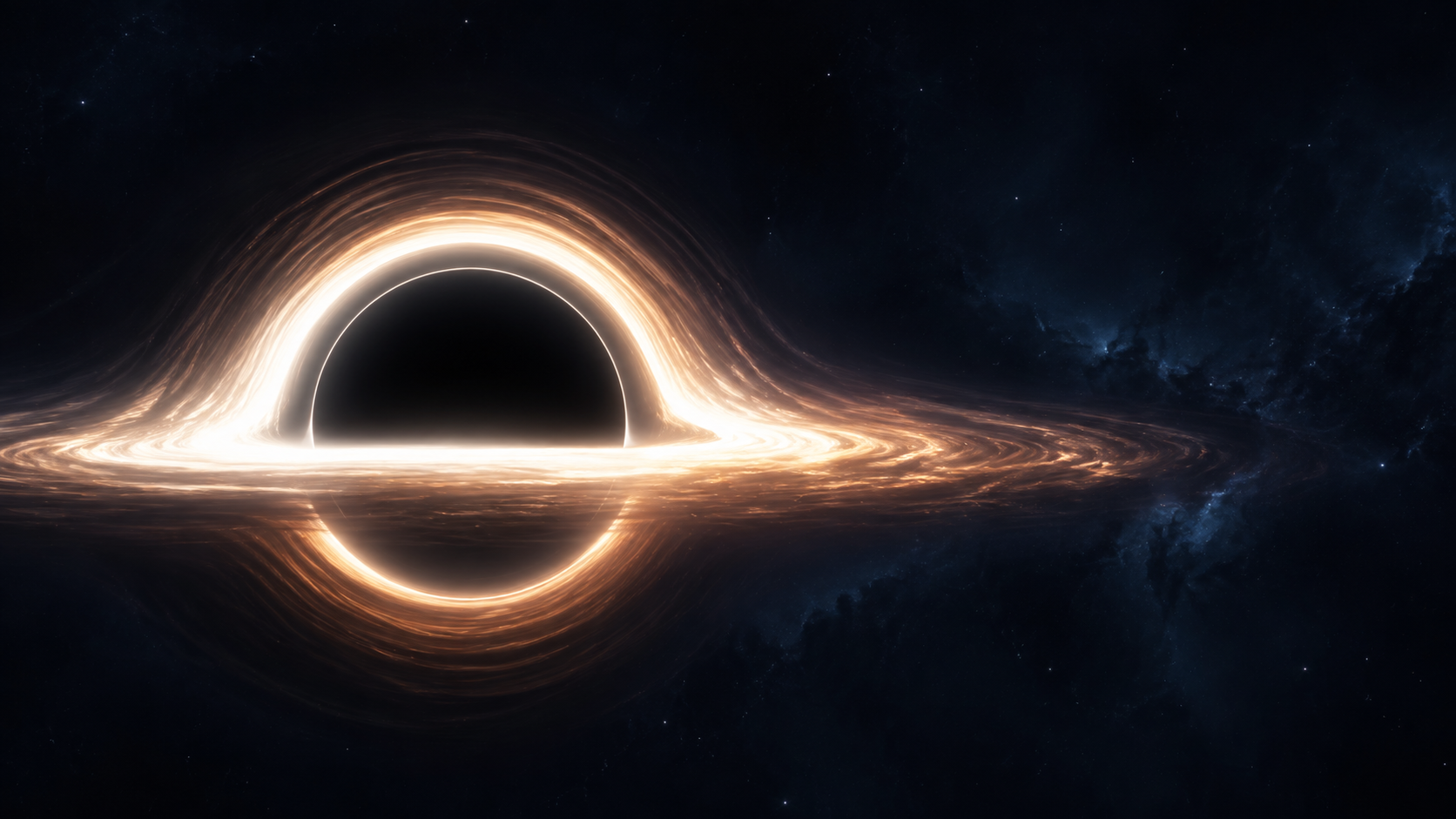
Black holes are among the most mysterious and fascinating objects in the universe. They are regions of spacetime where gravity is so strong that nothing, not even light, can escape. To understand black holes, we must dive into the deep physics of general relativity and the extreme limits of nature.
The Genesis of a Black Hole: Gravitational Collapse
A black hole is typically born from the death of a massive star. Stars are in a constant battle between two opposing forces: the outward pressure from nuclear fusion in their cores and the inward pull of their own gravity. For most of their lives, these forces are in balance. However, when a star at least three to five times more massive than our Sun exhausts its nuclear fuel, the outward pressure vanishes.
Without pressure to support it, the star's core collapses inward with incredible violence. In a fraction of a second, a core the size of Earth can be crushed into a point smaller than an atom. The outer layers of the star are often blown away in a cataclysmic supernova explosion, while the remnant core continues to collapse until it warps the very fabric of spacetime into a bottomless pit. This process, known as gravitational collapse, creates a stellar-mass black hole.
The Anatomy of a Black Hole: Key Regions
Contrary to popular belief, a black hole is not a solid object like a planet. Instead, it is a region of space defined by several key mathematical and physical boundaries:
- The Singularity: At the very center of a black hole lies the singularity. According to Einstein's equations, this is a point of infinite density where all the black hole's mass is concentrated. Here, our current laws of physics—including the General Theory of Relativity and Quantum Mechanics—clash and break down. The singularity represents a true "frontier" of human knowledge.
- The Event Horizon: This is the most famous part of a black hole—the "point of no return." It is a spherical boundary surrounding the singularity at a distance known as the Schwarzschild radius. Once an object crosses the event horizon, the escape velocity required to leave exceeds the speed of light. Since nothing in the universe can travel faster than light, anything crossing this boundary is lost forever to the outside world.
- The Photon Sphere: Just outside the event horizon, there is a region where gravity is so strong that photons (particles of light) are forced to travel in orbits. If you were standing in the photon sphere, light from your back could travel around the black hole and into your eyes, allowing you to see the back of your own head.
- The Accretion Disk: Many black holes are surrounded by a swirling disk of gas, dust, and stars that have been torn apart. As this material spirals inward, friction and gravity heat it to millions of degrees, causing it to glow brightly in X-rays and visible light. This is how we "see" black holes that would otherwise be invisible.
- Relativistic Jets: Some supermassive black holes launch powerful beams of particles and radiation from their poles at nearly the speed of light. These jets can span hundreds of thousands of light years and influence the evolution of entire galaxies.
General Relativity and the Curvature of Spacetime
To understand why black holes behave the way they do, we must look to Albert Einstein's General Theory of Relativity (1915). Einstein proposed that gravity is not a traditional force, but rather the curvature of the four-dimensional fabric of the universe: spacetime.
Massive objects like stars and planets create "dents" in this fabric. A black hole creates a hole so deep and steep that all paths through spacetime within the event horizon lead only one way: toward the singularity. In a very literal sense, once you are inside a black hole, the direction "out" no longer exists in your future.
Types of Black Holes: A Cosmic Hierarchy
Astronomers categorize black holes into three primary classes based on their mass and origins:
- Stellar-mass Black Holes: These are 5 to 100 times the mass of the Sun. They are the result of individual star deaths and are estimated to number in the hundreds of millions in our galaxy alone.
- Intermediate-mass Black Holes: With masses ranging from 100 to 100,000 Suns, these are the "middle children" of the black hole family. They may form through the merger of smaller black holes or in dense star clusters. Evidence for them is rare but growing.
- Supermassive Black Holes: These contain millions or billions of solar masses. They reside at the centers of nearly every large galaxy. The origin of these giants is still a subject of intense research, as they appear to have grown very quickly in the early universe. Our own galaxy's center hosts Sagittarius A*, a black hole with 4 million times the mass of the Sun.
Spaghettification and Time Dilation
The experience of falling into a black hole would be surreal. As you approach a stellar-mass black hole, you would experience extreme tidal forces. Because gravity increases so sharply over small distances, the pull on your feet would be vastly stronger than the pull on your head. This would stretch your body into a long, thin strand—a process known as "spaghettification."
Equally strange is the effect on time. According to relativity, gravity slows down time. From an outside observer's perspective, as you approach the event horizon, your clock would appear to slow down to a crawl. You would appear to hover at the edge of the horizon, getting redder and fainter (due to gravitational redshift) until you eventually disappear. You would never be seen actually crossing the horizon by someone outside.
Hawking Radiation: Do Black Holes Die?
For a long time, black holes were thought to be eternal. However, in 1974, Stephen Hawking combined relativity with quantum mechanics to propose Hawking Radiation. He suggested that near the event horizon, pairs of virtual particles are constantly popping into existence. Occasionally, one particle falls into the black hole while the other escapes.
The escaping particle carries away a tiny amount of the black hole's energy (and thus mass). Over incredibly long timescales, this causes the black hole to shrink and eventually evaporate in a final burst of radiation. For a black hole the mass of the Sun, this process would take about 10^67 years—vastly longer than the current age of the universe.
The First Images: M87* and Sagittarius A*
In 2019, the Event Horizon Telescope (EHT) collaboration released the first-ever image of a black hole's shadow. The image of M87*, a supermassive black hole 55 million light years away, showed a bright ring of light (the accretion disk) surrounding a dark central void. In 2022, the EHT released an image of our own Sagittarius A*. These images provided the most direct evidence to date that Einstein's predictions were correct even in the most extreme environments.
Conclusion
Black holes represent the ultimate extreme of the natural world. They challenge our perceptions of space, time, and reality. While they were once dismissed as mathematical curiosities, we now know they are essential components of our universe, shaping the galaxies they inhabit. As we continue to study them using gravitational waves and global telescope arrays, we move closer to solving the final mysteries of the cosmos.
Sources & Further Reading
- Event Horizon Telescope: eventhorizontelescope.org
- NASA Science: Black Holes: science.nasa.gov
- Harvard-Smithsonian CFa: cfa.harvard.edu
- Hawking, S. W. (1974). Black hole explosions? Nature, 248(5443), 30-31.
- Einstein, A. (1916). Die Grundlage der allgemeinen Relativitätstheorie. Annalen der Physik.