The Search for Exoplanets: How We Find Other Earths
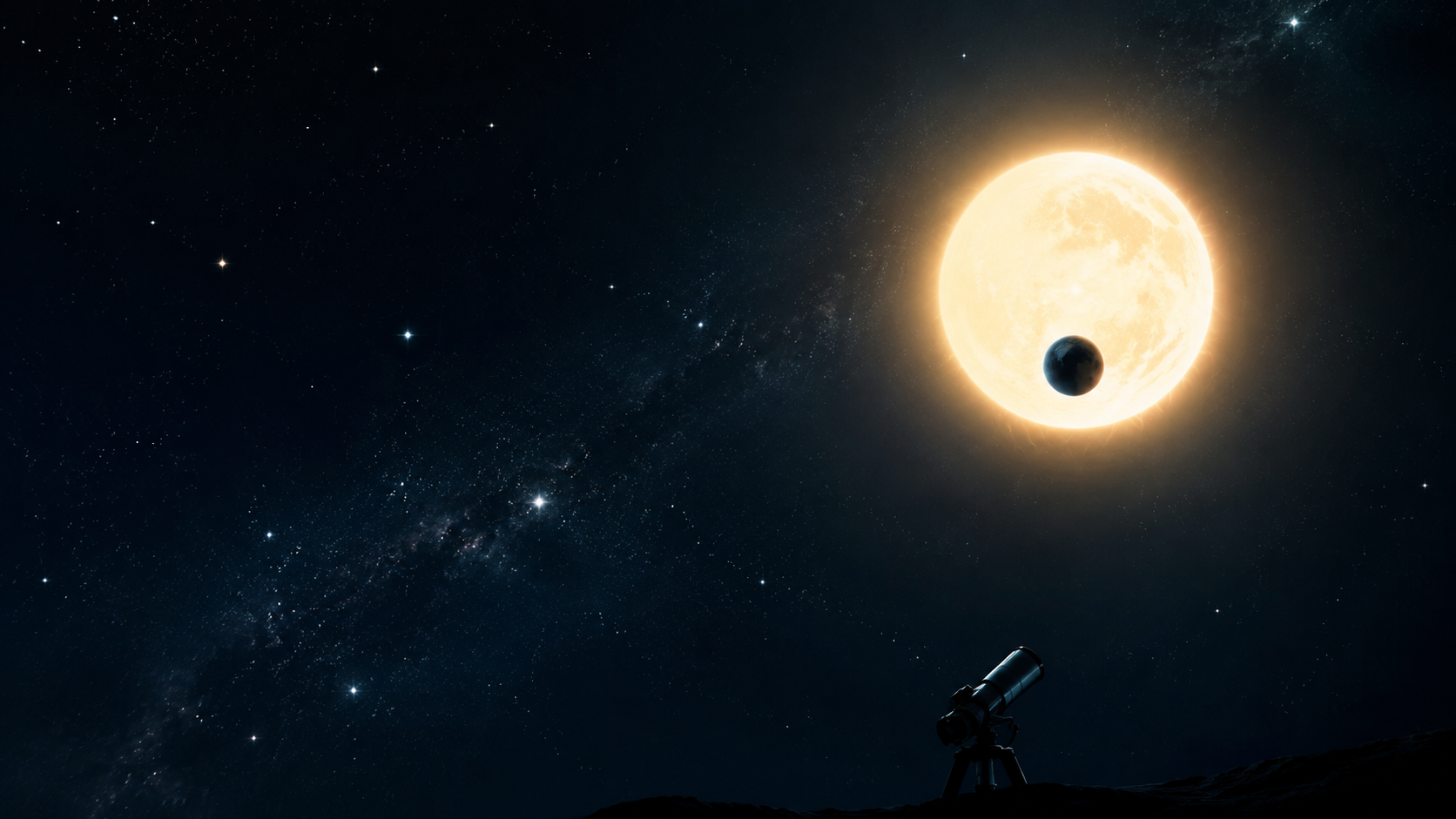
Are we alone in the universe? This age-old question has driven astronomers to search for planets orbiting stars other than our Sun—known as exoplanets. In the last three decades, our understanding of the cosmos has been transformed as we have discovered thousands of worlds, some of which may even be capable of supporting life.
The Dawn of Exoplanet Discovery
For centuries, the existence of other planetary systems was merely a matter of speculation. Philosophers like Giordano Bruno were burned at the stake for suggesting that other stars were suns with their own planets and inhabitants. It wasn't until the late 20th century that technology advanced enough to prove these ideas correct.
The first confirmed discovery of an exoplanet came in 1992, but it was not what anyone expected. Astronomers Aleksander Wolszczan and Dale Frail found two planets orbiting a pulsar—the dense, rapidly spinning remnant of a dead star. Because pulsars emit intense radiation, these worlds were certainly not habitable. In 1995, the discovery of 51 Pegasi b, the first planet found orbiting a Sun-like star, proved that planetary systems like our own are common throughout the galaxy. This discovery earned Michel Mayor and Didier Queloz the Nobel Prize in Physics in 2019.
The Transit Method: Catching a Shadow
The most successful technique for finding exoplanets is the transit method. When a planet's orbit is aligned so that it passes in front of its host star from our perspective, it blocks a tiny fraction of the star's light. By monitoring the brightness of thousands of stars simultaneously over long periods, astronomers can detect these subtle, periodic dips.
The transit method provides two critical pieces of information: the planet's orbital period (how long its year is) and its physical size (radius). The deeper the dip in light, the larger the planet. This method was the backbone of the highly successful Kepler Space Telescope mission, which discovered over 2,700 confirmed planets. Its successor, the Transiting Exoplanet Survey Satellite (TESS), is currently surveying the brightest stars in the entire sky to find planets around our nearest stellar neighbors.
Beyond simple detection, the transit method allows for transmission spectroscopy. As a planet passes in front of its star, a tiny amount of starlight filters through the planet's atmosphere. By analyzing the "missing" colors in that light, scientists can identify chemical signatures like water vapor, carbon dioxide, methane, and even clouds or hazes.
The Radial Velocity Method: The Stellar Wobble
Also known as the "Doppler method," this technique relies on the gravitational dance between a planet and its star. While we usually think of a star as stationary, the planet's gravity actually pulls on the star, causing it to move in a tiny circle or ellipse.
As the star "wobbles" toward and away from Earth, its light is slightly compressed or stretched. This is the Doppler Effect: light moving toward us is shifted toward the blue end of the spectrum, while light moving away is shifted toward the red. By measuring these precise shifts, astronomers can calculate the planet's minimum mass and its orbital distance. When combined with the transit method, which gives the planet's size, scientists can determine the planet's density—telling us if the world is rocky, icy, or gaseous.
Direct Imaging: Seeing the World Directly
Directly photographing a planet is incredibly difficult because the star it orbits is millions of times brighter. It's like trying to see a firefly hovering next to a searchlight from miles away. However, astronomers use a device called a coronagraph to block the star's glare, much like a car's sun visor.
Combined with advanced adaptive optics—mirrors that change shape 1,000 times a second to correct for Earth's atmospheric blurring—astronomers have successfully imaged dozens of young, hot, massive planets that are far from their stars. This method is the only way to directly measure a planet's temperature and rotational period.
Microlensing and Astrometry
Other methods include Gravitational Microlensing, which uses the gravity of a foreground star to act as a magnifying glass for a more distant star. If the foreground star has a planet, it creates an extra "blip" in the magnification. This method is unique because it can find planets very far from Earth and even "rogue planets" that don't orbit any star.
Astrometry involves measuring the precise position of a star in the sky to see if it moves in a tiny circle due to a planet's gravity. While conceptually simple, it requires extreme precision that has only recently become possible with space missions like Gaia.
The Habitable Zone: The "Goldilocks" Region
One of the primary goals of exoplanet science is to find planets in the Habitable Zone. This is the region around a star where the temperature is just right for liquid water to exist on a planet's surface. Water is the universal solvent for life as we know it, making these regions prime targets for the search for biosignatures.
The boundaries of the habitable zone depend on the star's temperature. For a cool red dwarf star like TRAPPIST-1, the habitable zone is much closer than it is for our Sun. TRAPPIST-1 is a remarkable system with seven Earth-sized planets, three of which reside in the habitable zone. These worlds are currently being studied by the James Webb Space Telescope to see if they possess atmospheres and water.
Exoplanet Diversity: A Cosmic Zoo
The search has revealed a surprising diversity of worlds that look nothing like our own solar system. We have found:
- Hot Jupiters: Massive gas giants that orbit so close to their stars that their atmospheres are heated to thousands of degrees. They were the first type of exoplanet found because they are the easiest to detect.
- Super-Earths: Planets with masses between Earth and Neptune. These are the most common type of planet found in the galaxy, yet we have none in our own solar system. They can be rocky, water-worlds, or "mini-Neptunes."
- Ocean Worlds: Planets that may be entirely covered by deep oceans, with no land in sight.
- Lava Worlds: Rocky planets orbiting so close to their stars that their surfaces are molten.
- Circumbinary Planets: Planets that orbit two stars at once, like Tatooine from Star Wars.
The Future: Looking for Life
We are moving from an era of "discovery" to an era of "characterization." Upcoming missions like the ESA's PLATO and ARIEL, and NASA's Habitable Worlds Observatory (a future successor to Webb), will focus on finding Earth-like planets around Sun-like stars and searching for biosignatures.
Biosignatures are gases in a planet's atmosphere that are produced by biological processes, such as oxygen, ozone, nitrous oxide, and methane. Detecting these in the right proportions would be a smoking gun for life elsewhere. While we haven't found a "Twin Earth" yet, the statistics suggest that there are billions of potentially habitable worlds in our galaxy alone. The discovery of life beyond Earth may be just a matter of time.
Sources & Further Reading
- NASA Exoplanet Archive: caltech.edu
- NASA Exoplanet Exploration: nasa.gov
- The Planetary Society: planetary.org
- Mayor, M., & Queloz, D. (1995). A Jupiter-mass companion to a solar-type star. Nature, 378(6555), 355-359.
- Seager, S. (2010). Exoplanet Atmospheres: Physical Processes. Princeton University Press.