Gravitational Waves: Ripples in the Fabric of Spacetime
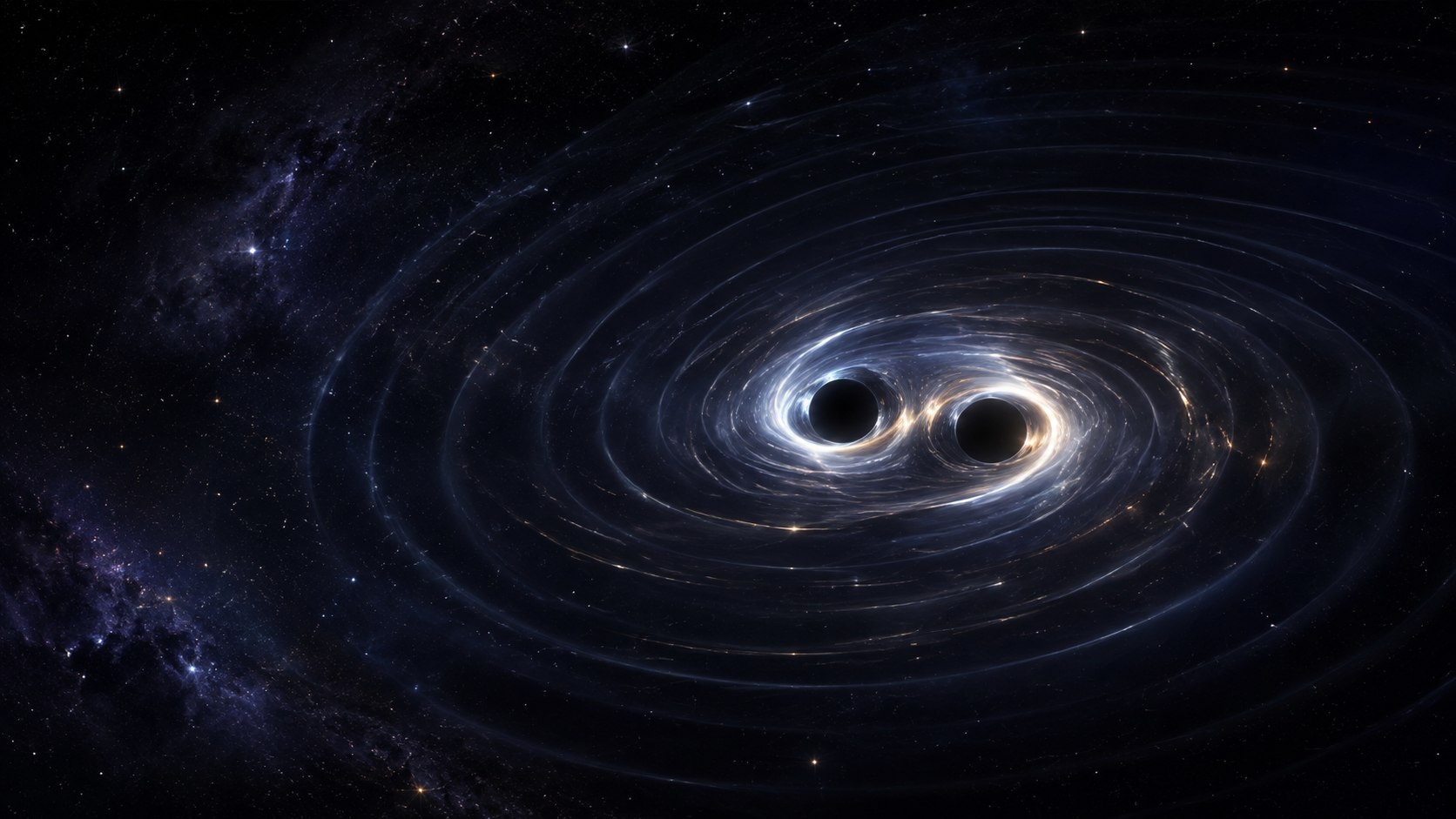
In 1916, Albert Einstein predicted that violent cosmic events could create ripples in the fabric of spacetime itself. It took a century of technological advancement to prove him right. The discovery of gravitational waves has opened a new window into the universe, allowing us to "hear" the cosmos for the first time.
Einstein's Prediction
According to Einstein's General Theory of Relativity, gravity is not a force, but a curvature of spacetime caused by mass and energy. Einstein realized that when massive objects accelerate, they should create waves that travel through space at the speed of light. These gravitational waves stretch and squeeze space as they pass, but the effect is unimaginably small. Einstein himself doubted whether they would ever be detected.
The first indirect evidence arrived in 1974, when Joseph Taylor and Russell Hulse discovered a binary system of two neutron stars, one of them a pulsar. By timing the pulsar's radio pulses over many years, they showed that the two stars were slowly spiraling toward each other at exactly the rate predicted if the system were losing energy in the form of gravitational waves. The discovery earned them the 1993 Nobel Prize in Physics and convinced most physicists that the waves were real—but direct detection remained out of reach.
LIGO: The Most Precise Measuring Tool
The detection of these waves required the construction of the Laser Interferometer Gravitational-Wave Observatory (LIGO). LIGO consists of two identical facilities—one in Washington and one in Louisiana—each with two 4-kilometer-long arms arranged in an "L" shape.
LIGO uses lasers to measure the length of these arms with incredible precision. When a gravitational wave passes, it causes one arm to lengthen and the other to shorten by a distance smaller than the width of a proton. Achieving this level of sensitivity meant isolating the mirrors from every possible vibration, from distant earthquakes to nearby traffic.
The First Detection: GW150914
On September 14, 2015, LIGO detected a signal that would change physics forever. The signal, dubbed GW150914, matched the predicted waveform of two black holes spiraling into each other and merging. These black holes, 29 and 36 times the mass of the Sun, collided 1.3 billion light years away.
The collision released more energy in the form of gravitational waves in a fraction of a second than all the stars in the visible universe release as light. This discovery confirmed Einstein's prediction and provided the first direct evidence of black hole mergers. The leaders of the LIGO project were awarded the Nobel Prize in Physics in 2017.
Multi-Messenger Astronomy
In August 2017, LIGO and its European counterpart, Virgo, detected a different kind of signal: the merger of two neutron stars (GW170817). Unlike black hole mergers, which are "dark," neutron star collisions produce intense light.
Telescopes around the world were alerted and observed the event across the entire electromagnetic spectrum, from gamma rays to radio waves. This event, known as a kilonova, confirmed that neutron star mergers are a primary source of heavy elements like gold and platinum in the universe. This was the birth of "multi-messenger astronomy," where we can both "hear" and "see" the same cosmic event.
Why It Matters
For thousands of years, we have explored the universe using light. But most of the universe is dark. Gravitational waves allow us to observe objects that don't emit light, like black holes, and to see further back into the history of the universe than light allows. They provide a new way to test our theories of gravity in the most extreme environments.
The Future of Gravitational Wave Astronomy
New detectors are being planned to expand our reach. The LISA (Laser Interferometer Space Antenna) mission, led by the ESA, will put a gravitational wave detector in space. With arms millions of kilometers long, LISA will be able to detect waves from much more massive objects, such as supermassive black holes at the centers of galaxies.
Meanwhile, another technique has already extended our hearing to the lowest frequencies. In 2023, pulsar timing arrays such as NANOGrav announced evidence for a background "hum" of gravitational waves produced by supermassive black hole pairs throughout the universe. By monitoring dozens of millisecond pulsars across the galaxy for over a decade, astronomers can detect tiny shifts in the arrival times of their radio pulses caused by passing waves. Together, ground-based detectors, space missions, and pulsar timing are building a full spectrum of gravitational wave astronomy.
Conclusion
The discovery of gravitational waves is one of the greatest scientific achievements of the 21st century. It has transformed our understanding of the universe from a silent, visual spectacle into a dynamic, vibrating symphony. As we listen more closely to the ripples in spacetime, we will undoubtedly uncover even more profound truths about the nature of our reality.
Sources & Further Reading
- LIGO Lab: ligo.caltech.edu
- Virgo Collaboration: virgo-gw.eu
- NASA Science: Gravitational Waves: science.nasa.gov
- Abbott, B. P., et al. (2016). Observation of Gravitational Waves from a Binary Black Hole Merger. Physical Review Letters.