The Lifecycle of Stars: From Nebula to Supernova
Stars are the engines of the universe. They create the elements necessary for life, illuminate the darkness of space, and drive the evolution of galaxies. Yet, like all things, stars are born, live, and eventually die.
Birth in the Clouds: The Protostar
The journey of every star begins in a nebula—a vast, cold cloud of gas and dust. These "stellar nurseries" can span hundreds of light years and contain enough material to form thousands of stars. Triggered by a shockwave from a nearby supernova or a gravitational disturbance, regions within the nebula begin to collapse under their own gravity.
As the gas falls inward, it heats up, forming a dense core called a protostar. Surrounded by a disk of remaining material (from which planets may later form), the protostar continues to accumulate mass and grow hotter. Once the core temperature reaches about 10 million Kelvin, hydrogen nuclei begin to fuse into helium, releasing a tremendous amount of energy. A star is born.
The Main Sequence: A Delicate Balance
The longest stage of a star's life is the Main Sequence. During this phase, the star exists in a state of hydrostatic equilibrium, where the inward pull of gravity is perfectly balanced by the outward pressure from nuclear fusion in its core. Our Sun is currently in this stable phase and will remain so for another 5 billion years.
A star's mass determines its lifespan and its color. Massive stars are hot, blue, and burn through their fuel in just a few million years. Smaller stars, like red dwarfs, are cool, dim, and can live for trillions of years—longer than the current age of the universe.
Astronomers map these differences using the Hertzsprung-Russell (H-R) diagram, a chart that plots each star's brightness against its surface temperature. When thousands of stars are plotted, clear patterns emerge: the main sequence forms a graceful band across the diagram, while giant and white dwarf stars occupy distinct regions of their own. Reading an H-R diagram is like reading a star's biography, revealing its mass, its age, and its eventual fate at a single glance.
Old Age: The Red Giant Phase
When a star exhausts the hydrogen in its core, the balance shifts. Gravity begins to win, and the core contracts and heats up even further. This heat causes the outer layers of the star to expand and cool, transforming the star into a Red Giant.
In this phase, a star like the Sun will expand to swallow the inner planets, including Mercury, Venus, and possibly Earth. In the core, the star begins to fuse helium into heavier elements like carbon and oxygen.
The Final Act: Low-Mass Stars
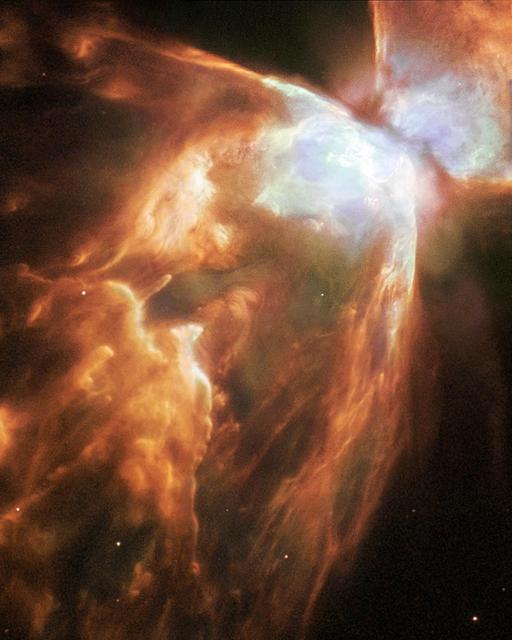
For stars like the Sun, the end is relatively gentle. Once they can no longer fuse heavier elements, they shed their outer layers into space, creating a beautiful Planetary Nebula. The remaining core, about the size of Earth but with the mass of a star, becomes a White Dwarf. Over billions of years, this white dwarf will slowly cool and fade away, eventually becoming a dark, cold "Black Dwarf."
The Final Act: High-Mass Stars
Massive stars meet a much more violent end. They continue to fuse heavier and heavier elements—neon, magnesium, silicon—until they reach iron. Fusing iron consumes energy rather than releasing it, causing the core to collapse in a fraction of a second.
The resulting rebound creates a Supernova—one of the most energetic events in the universe, briefly outshining entire galaxies. This explosion scatters heavy elements across space, seeding the next generation of stars and planets with the building blocks of life.
Astronomers witnessed this process directly in 1987, when a blue supergiant in the Large Magellanic Cloud exploded as SN 1987A, the brightest supernova visible from Earth in nearly four centuries. Because the star had been catalogued before its death, and because detectors on Earth caught its neutrinos hours before the light arrived, SN 1987A became a goldmine for testing every theory we have about how massive stars die.
Remnants: Neutron Stars and Black Holes
What remains after a supernova depends on the mass of the collapsed core. If the core is between 1.4 and 3 times the mass of the Sun, it becomes a Neutron Star—an object so dense that a teaspoon of its material would weigh a billion tons. If the core is even more massive, it collapses completely into a Black Hole, a point of infinite density from which not even light can escape.
Conclusion
The lifecycle of a star is a cycle of cosmic recycling. From the ashes of dead stars, new ones are born. As Carl Sagan famously said, "We are made of starstuff." Every atom of carbon in your body, every breath of oxygen, was forged in the heart of a star billions of years ago. Understanding the lives of stars is, in a very real sense, understanding ourselves.
Sources & Further Reading
- NASA Science: Stars: science.nasa.gov
- ESA: The Life of a Star: esa.int
- Hubble Space Telescope: Nebulae: hubblesite.org