The Voyager Interstellar Mission: Humanity's Farthest Reach
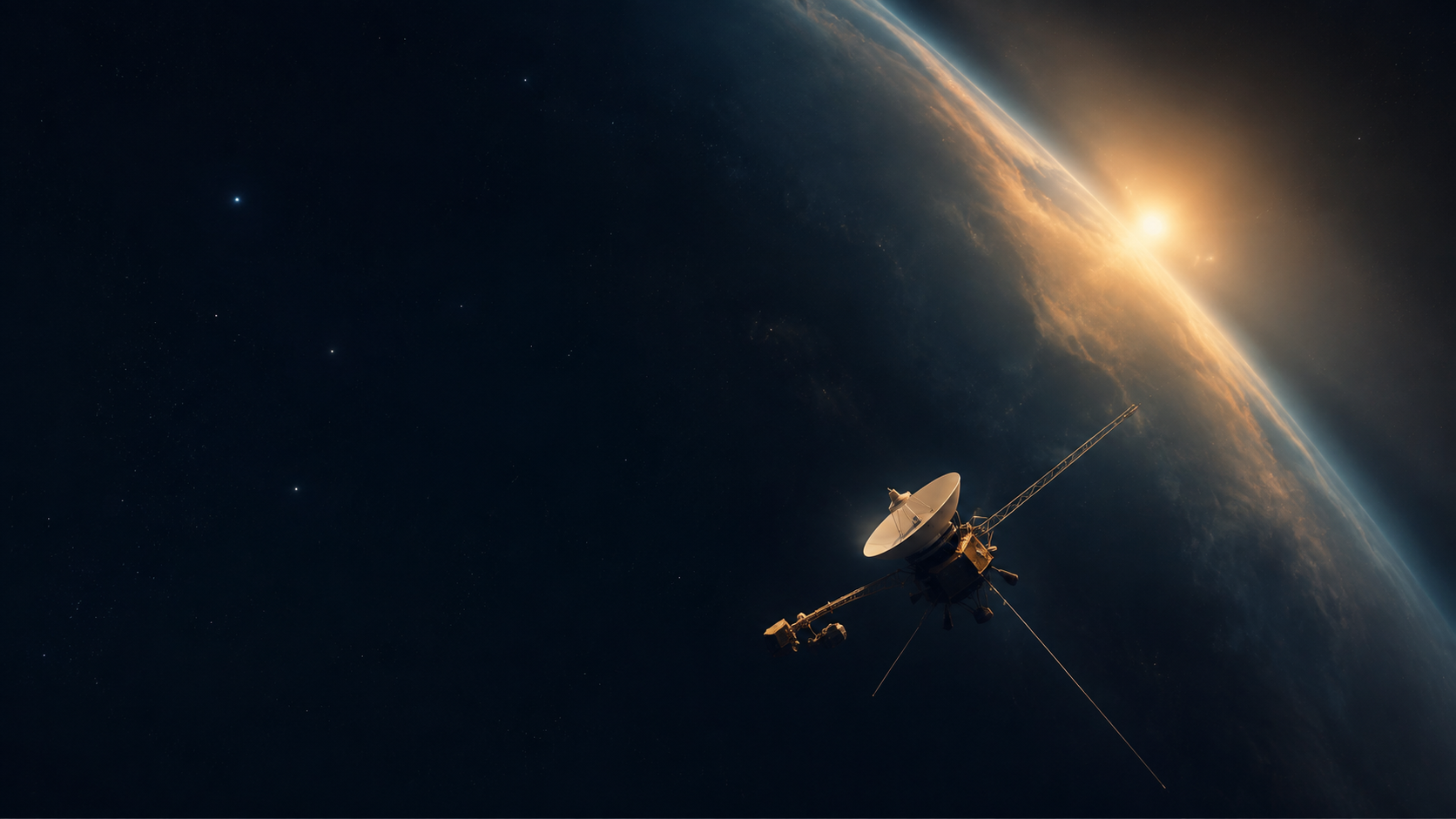
Launched in 1977, the twin Voyager 1 and 2 spacecraft have traveled further than any human-made objects in history. They have explored the outer planets, crossed into interstellar space, and continue to send data back to Earth from billions of miles away.
The Grand Tour
The Voyager mission was born from a rare celestial alignment that occurs only once every 176 years. In the late 1970s, the four outer planets—Jupiter, Saturn, Uranus, and Neptune—were positioned in a way that a single spacecraft could visit all of them using "gravity assists" to sling itself from one planet to the next.
Voyager 2 was launched first on August 20, 1977, followed by Voyager 1 on September 5. While Voyager 1 took a faster trajectory to visit Jupiter and Saturn before heading out of the ecliptic plane, Voyager 2 went on to complete the "Grand Tour," becoming the only spacecraft to ever visit Uranus and Neptune.
Discoveries at the Giants
The Voyagers revolutionized our understanding of the outer solar system. They discovered:
- Active Volcanoes on Io: The first evidence of active volcanism on a body other than Earth.
- Complex Rings: Detailed views of Saturn's rings and the discovery of rings around Jupiter, Uranus, and Neptune.
- New Moons: Dozens of previously unknown moons orbiting the outer planets.
- Atmospheric Secrets: The Great Red Spot on Jupiter was revealed to be a complex, swirling storm, and Neptune was found to have the fastest winds in the solar system.
Keeping in touch with spacecraft so far away is an engineering triumph in its own right. A radio signal from Voyager 1 now takes more than 22 hours to reach Earth, and by the time its faint 23-watt transmission arrives, it is billions of times weaker than a watch battery. Only NASA's Deep Space Network, with its giant 70-meter antennas in California, Spain, and Australia, can capture that whisper of a signal and decode the data inside it.
The Pale Blue Dot
In 1990, as Voyager 1 was leaving the solar system, it turned its camera back toward Earth one last time. From a distance of 6 billion kilometers, Earth appeared as a tiny, flickering "pale blue dot" suspended in a sunbeam. This iconic image, taken at the request of astronomer Carl Sagan, serves as a powerful reminder of the fragility and smallness of our home in the vastness of space.
Entering Interstellar Space
After completing their primary missions, the Voyagers began their "Interstellar Mission." Voyager 1 became the first human-made object to cross the heliopause—the boundary where the solar wind meets the interstellar medium—in August 2012. Voyager 2 followed in November 2018.
Now in the space between the stars, the Voyagers are measuring the density and temperature of the interstellar plasma, providing our first direct data from outside the Sun's influence. These measurements are the only in-situ observations of this distant region, and they will remain unique for many years, until newer missions reach equally far.
The Golden Record: A Message to the Future
Each Voyager carries a 12-inch gold-plated copper disk containing sounds and images selected to portray the diversity of life and culture on Earth. The Golden Record includes greetings in 55 languages, music from Bach to Chuck Berry, and sounds of wind, thunder, and birds. It is a time capsule intended for any extraterrestrial civilization that might encounter the spacecraft in the distant future. Even if they are never found, the records will outlast humanity itself, wandering the galaxy for billions of years.
The Final Chapters
The Voyagers are powered by radioisotope thermoelectric generators (RTGs) that use the heat from decaying plutonium-238. This power source is slowly declining, and NASA has had to turn off non-essential instruments to keep the spacecraft operating. It is expected that by the early 2030s, the Voyagers will no longer have enough power to communicate with Earth. They will then continue their silent journey through the Milky Way, potentially outliving the Earth and the Sun.
Their resilience is legendary. In late 2023, Voyager 1 began sending back unintelligible gibberish after a memory chip in one of its onboard computers failed. Engineers at JPL spent months devising a fix and, in April 2024, successfully relocated the broken code into spare memory—patching a computer located more than 24 billion kilometers away, nearly half a century after launch. Few machines in history have proven so durable.
Conclusion
The Voyager mission is a testament to human ingenuity and the spirit of exploration. These two small craft, built with technology less powerful than a modern smartphone, have rewritten our understanding of the solar system and become our first ambassadors to the stars. They represent the very best of what we can achieve when we look up and wonder.
Sources & Further Reading
- NASA Voyager Mission Official Site: voyager.jpl.nasa.gov
- JPL Voyager Mission Status: jpl.nasa.gov
- The Golden Record: voyager.jpl.nasa.gov/golden-record
- Sagan, C. (1994). Pale Blue Dot: A Vision of the Human Future in Space.