Atmospheric Refraction: Why a Low Star Appears Higher
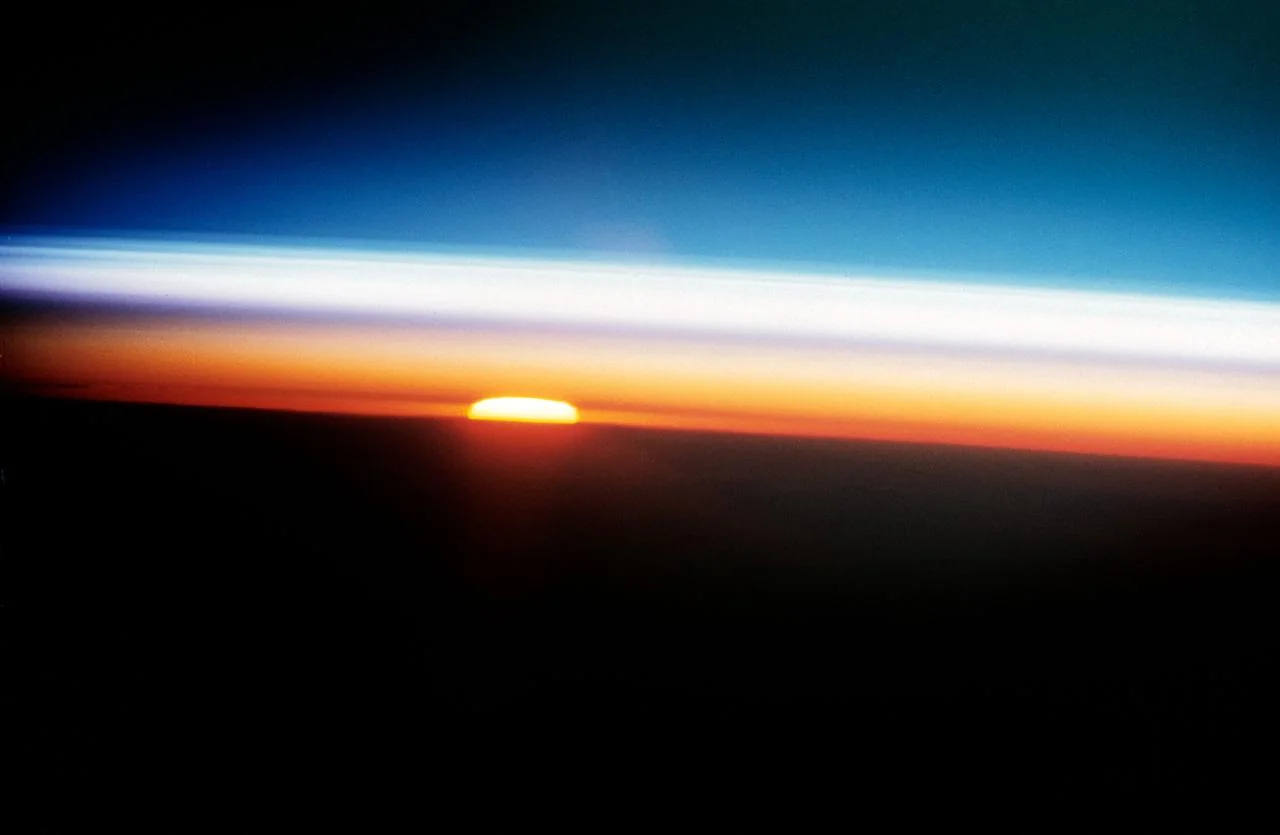
A star close to the horizon can appear higher than its unrefracted direction. Its light passes through layers of Earth's atmosphere and bends as the refractive index changes. This matters when comparing a calculated position with an observation, particularly at low altitude. A compact refraction formula gives a useful estimate, but a neat correction should never be mistaken for a direct measurement of the atmosphere above your observing site.
Separate apparent and geometric altitude
Altitude is the angle above the horizon, reaching ninety degrees at the zenith. Geometric altitude describes the direction without atmospheric bending. Apparent altitude includes refraction. In ordinary conditions refraction raises the apparent position, so correcting an apparent altitude back to a geometric one requires subtracting the refraction angle rather than adding it again.
Formula conventions matter because some approximations start with apparent altitude and others with geometric altitude. Their inputs cannot be swapped without introducing error. The Atmospheric Refraction Calculator uses apparent altitude in a Bennett style expression and reports the correction in arcminutes. Read that label before comparing it with a planetarium's output, which may already include an atmospheric model or offer an option to switch refraction off.
Read the output in the right unit
One degree contains sixty arcminutes. At an apparent altitude of ten degrees, the site's standard atmosphere approximation gives about 5.39 arcminutes, equivalent to roughly 0.090 degrees. Subtracting that correction places the approximate geometric altitude near 9.910 degrees. Subtracting 5.39 degrees instead would be a major unit mistake, even though the arithmetic itself is straightforward.
At forty five degrees, the correction is about one arcminute. It declines toward the zenith, where the tool sets it to zero. Try those values in sequence to see the trend. The fast increase toward the horizon explains why two position calculations may agree well overhead yet disagree noticeably when a target is low, especially if their refraction settings differ.
Understand the atmosphere assumed
The calculator uses a standard condition approximation with no local weather input. It does not download pressure, temperature, or a forecast. Actual refraction responds to air density and the vertical structure along the light path. Pressure and temperature corrections can improve suitable models, but a surface thermometer alone cannot reconstruct all the layers that a nearly horizontal ray traverses.
This is particularly relevant over water, snow, or hot ground, where unusual temperature gradients can create mirage effects. A standard formula may give the usual direction of correction while failing to describe the detailed image. The tool is intended for learning and rough comparison. It should not be used as a sole correction for precision astrometry, navigation, or a safety critical observation.
Keep refraction separate from seeing and extinction
Refraction shifts an apparent direction. Seeing describes time varying image distortions and blur caused by atmospheric turbulence. Extinction reduces light reaching the observer through absorption and scattering. These effects can occur together, but changing one calculator output does not remove the others. A corrected coordinate can still correspond to an unsteady, faint, or colour fringed image.
Atmospheric dispersion adds a further complication: different wavelengths bend by different amounts. This can produce coloured edges around a low planet. An atmospheric dispersion corrector addresses that wavelength dependent separation in suitable observing setups; it does not make the atmosphere transparent or eliminate all turbulence. Avoid assuming a single refraction number predicts the quality of a high magnification planetary view.
Treat the horizon with extra care
The calculator accepts apparent altitudes from zero to ninety degrees. At the horizon it returns approximately 34.48 arcminutes under its adopted model. Actual horizon refraction can vary considerably. A sea horizon, a hilltop, and a skyline blocked by trees also represent different observing geometries. Terrain and observer height need their own treatment when interpreting a rise or set calculation.
Sunrise and sunset conventions add the apparent size of the solar disk and an adopted atmospheric correction. They are not simply the moment when the Sun's centre has a geometric altitude of zero. The site's refraction page does not calculate sunrise or sunset times. Do not convert its horizon estimate into a timetable without a separate position model and clearly stated event definition.
Build a useful comparison note
When investigating a position discrepancy, record the target, UTC instant, observing site, and altitude convention first. Note whether your reference software includes refraction and which weather values it uses. Then compare results at a moderate altitude before looking at the horizon. This helps distinguish a sign or unit error from disagreement between atmospheric models.
For a practical session, observing an object higher in the sky often avoids the most difficult low altitude conditions, although the available geometry depends on your location and target. Use the calculator to understand the correction's scale and direction. Keep the assumptions beside the result, and retain your actual observation separately so a theoretical estimate does not quietly become a measured fact.
If a copied result looks implausible, first check whether an altitude was entered as a zenith distance. Zenith distance is measured downward from the point overhead, so it equals ninety degrees minus altitude. Substituting one for the other can reverse the expected trend. This is a coordinate convention error that no weather adjustment can repair, and it is worth checking before changing the atmospheric model.
Related reading
 Physics
The Big Bang Theory: The Origins of Everything
How did the universe begin? Explore the evidence for the Big Bang theory, from Hubble's expanding universe to the Cosmic Microwave Background radiation.
 Physics
Dark Matter and Dark Energy: The Invisible Universe
Dark matter and dark energy make up 95% of the universe. Learn how astronomers discovered them and why they hold the key to the ultimate fate of the cosmos.